
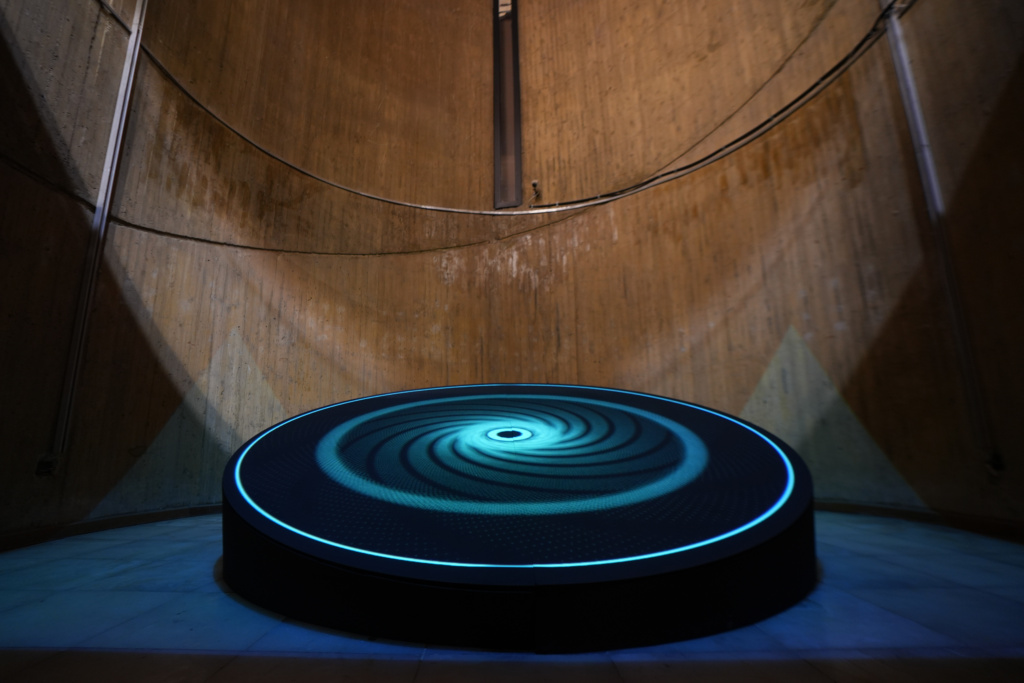
“Phillotaxis” by Nourathar Studio [Patternitechture #4]
Nourathar Studio’s Phillotaxis explores the generative potential of patterns as both structure and process. Using the Vogel method of circular distribution, the installation translates organic growth systems—such as sunflower spirals and DNA helices—into dynamic, computational geometries.
Its hypnotic visuals and artificial soundscapes evoke cycles of expansion and collapse, blurring boundaries between natural and digital, organic and synthetic. Phillotaxis reflects the patterns as frameworks that affect perception, space, and transformation in the contemporary world.
Image, sound, and programming by Caen Botto.
more
Patternitecture #3: Patterns in contemporary built-environment
iteration, Patternitecture invites designers and artists from various disciplines of art, design and architecture to submit their proposals to address the role and function of pattern in the human-made environments of contemporary Iran.
Pattern has been employed by humans through various approaches and methods throughout history. Following the needs of culture, it has appeared in a variety of shapes to serve different concepts. From time to time, it has been re-examined and emerged with a new appearance. Pattern is a reflection of nature and represents the interaction between humans and the natural environment around them. The simplification, then repetition of pictorial elements of animals and plants in early human ages, in European classical golden ratios, in Islamic geometrical motifs, fractals, Quasicrystals and digital complex motifs are main parts of the historical evolution of pattern in human history. In
, pattern became a significant part of the artistic style and other times, it was not as notable. Through its abstract form, pattern is used to rearrange chaotic relationships in nature to create balance and harmony in our eyes. It seems that pattern is essential in the process of design since pattern creates a dynamic association between the artistic creativity and the audience of an artwork. Pattern has never lost this capability, instead has become a major artistic tool for designers as an aesthetic solution to tackle the matters of creating spaces for the human inhabitancy, beautifying it and implementing it in architecture. Today, all repetitive and expansive patterns that stem from several resources such as nature, mathematics, geometry, abstraction and our social behaviors, are recognized as contemporary patterns. The rule of mere repetition in these patterns is outdated, and expansiveness is integrated into the repetitive quality in order to shape a series of novel patterns. These new patterns although are formally more complicated then before, they seem more flexible and adaptive that could have a more active role in our environment. In the architecture context, pattern is beyond just a bare embellishment and becomes an active form or a part of a structure. These new and sometimes unfamiliar patterns create opportunities for new alternatives to communicate with people.
Patternitecture 3, is looking for concepts and messages that are delivered by contemporary patterns in art and architecture that aim to improve the human-made environments and turn it to a better place to live. This exhibition will respond to this question of how patterns can be the reflection of the designers’ imaginations to help create an effective connection between the work, its audience and the context.
more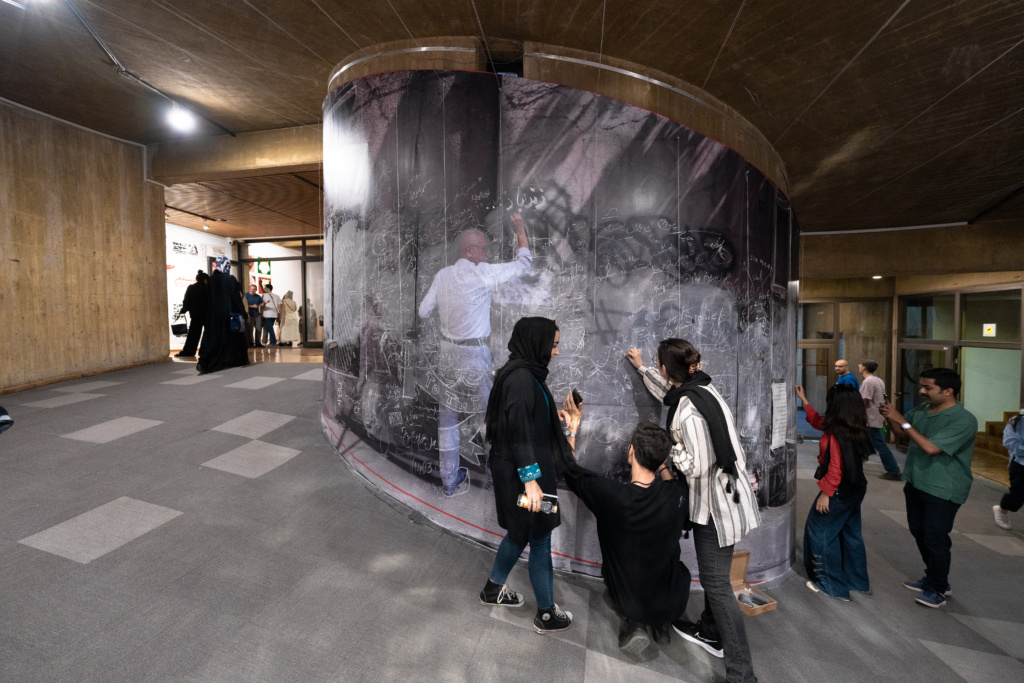
“My City” by Kamran Safamanesh [Patternitecture #4]
Kamran Safamanesh’s My City is a conceptual exploration of the essence of cities, emphasizing the continuous processes of change. Through concepts such as transformation, rewriting, demolition, renovation, and reconstruction, Safamanesh demonstrates how cities are shaped by human actions, reactions, and interactions. This work presents the city as a living entity, constantly changing, decaying, and renewing. The city becomes a mirror of its people, reflecting their behaviors, dialects, and aspirations, transforming it into both an individual and collective experience.
In the context of the Patternitecture #4 exhibition, titled
“Boundaries That Expand; Where We Stand,” My City is directly linked to the concept of borders and change. This installation examines the constant changes and urban transformations as a metaphor for fluid and ever-changing boundaries. Just as cities are built, demolished, and rebuilt, the boundaries of our lives also continuously evolve and redefine themselves. The work invites visitors to reflect on the hidden energies and complexities of urban life and the relationship between humans and their urban environments.
Kamran Safamanesh, an architect and urban theorist, is the founder of the Tehran Research Institute and has completed over 220 architectural, urban design, and restoration projects.
His extensive research in the theory, history, and experience of Iranian architecture and urbanism has created a comprehensive archive and made a significant impact in the field.
more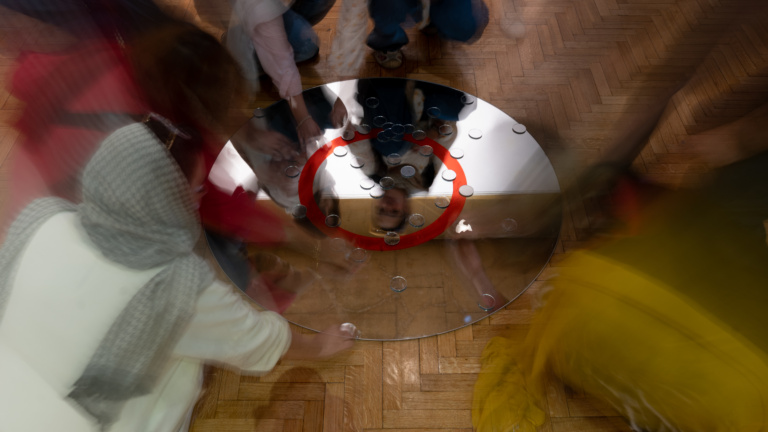
“Boundaries That Expand; Where We Stand” By Bita Shekari, Ghazal Refalian [Patternitecture #4]
In “Boundaries That Expand; Where We Stand”, curators Bita Shakari and Ghazal Rafalian invite viewers to explore the dynamic relationship between individuals and the boundaries that define their worlds. The installation asks participants to engage with their own reflection in a mirror, positioning it in a way that reveals their personal relationship with the boundaries they know—be they physical, social, or psychological.
This thought-provoking piece challenges our perceptions of borders, highlighting the fluid and evolving nature of the spaces we inhabit. It calls on us to consider how we perceive, interact with, and position ourselves within the boundaries of our lives, questioning what it means to stand within a space that is constantly shifting.
Bita Shakari, an artist, designer, and independent curator based in Tehran, and Ghazal Rafalian, an architect, artist and curator based in Barcelona, specializes in experimental space design and digital fabrication.
more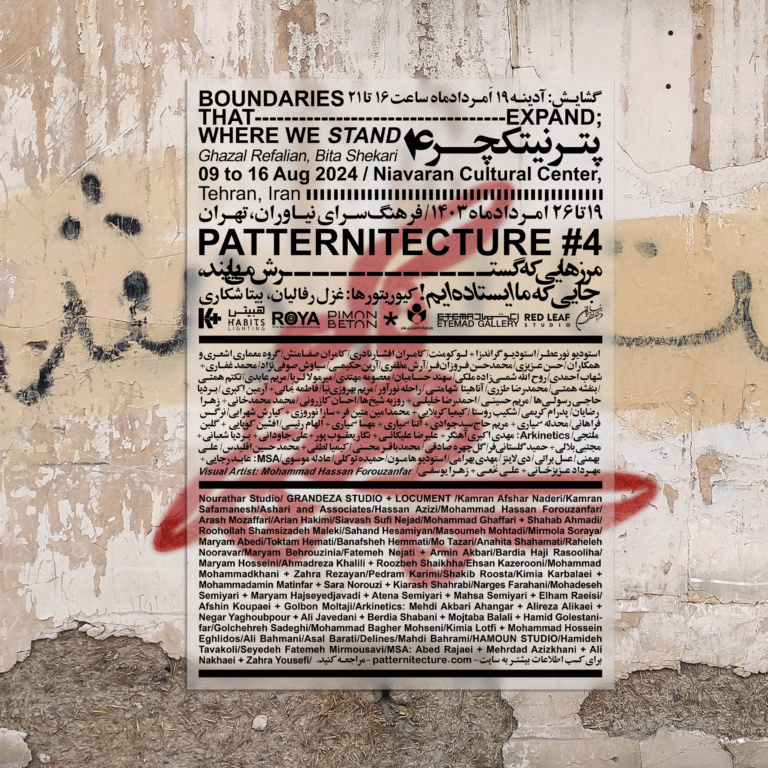
Patternitechture #4: “Boundaries that expand; Where we Stand.”
Patternitechture #4, titled “Boundaries that expand; Where we Stand.” places the focus of its projects and programs on the exploration of the “World of new patterns”.Through this lens, it aims to study the relationship of patterns with the city, nature, society and people within the context of the contemporary world.
Patterns are a medium to recognize and redefine the world. They enable us to establish meaningful connections with objects and ideas. A structured, controllable, and replicable connection that shapes our environment and provides a foundation for extending our perceptions and creating new forms. The pursuit of discovering and establishing order, and controlling chaos in this environment, has not only been an endeavor in the realm of knowledge but has also been embraced by many artists to create mirrors of the world they perceive. Through the creation of abstract worlds, they celebrate this manifest order.
Although we discuss the extension and repetition of structures, replicable patterns are not condemned to eternal repetition; rather, they possess a highly dynamic and living nature. Like living beings, they are born, grow, mature, and ultimately give way to new patterns. Today we witness that advanced tools related to artificial intelligence are erasing the boundaries of knowledge production and toolmaking across all fields, altering the previous structures of society. Yet, the average user has not clearly defined their relationship with digital tools. We face a new generation of knowledge and technology that has redefined our interaction with subjects and, now, with the accelerating emergence of innovative tools, the question arises: how can the modern human redefine their relationship with new patterns?
Patternitechture has always been devoted to exploring patterns that have been effective in shaping the built environment, providing not only a space for reflecting contemporary designers’ efforts but also an opportunity to create new patterns that pave the way for addressing the contemporary human’s demands from their living environment. This event invites all enthusiasts as an opportunity for idea exchange and discussion about the role of patterns in architecture and art. It encourages participation in this shared quest, creating a unique, inspiring, and transformative space.
more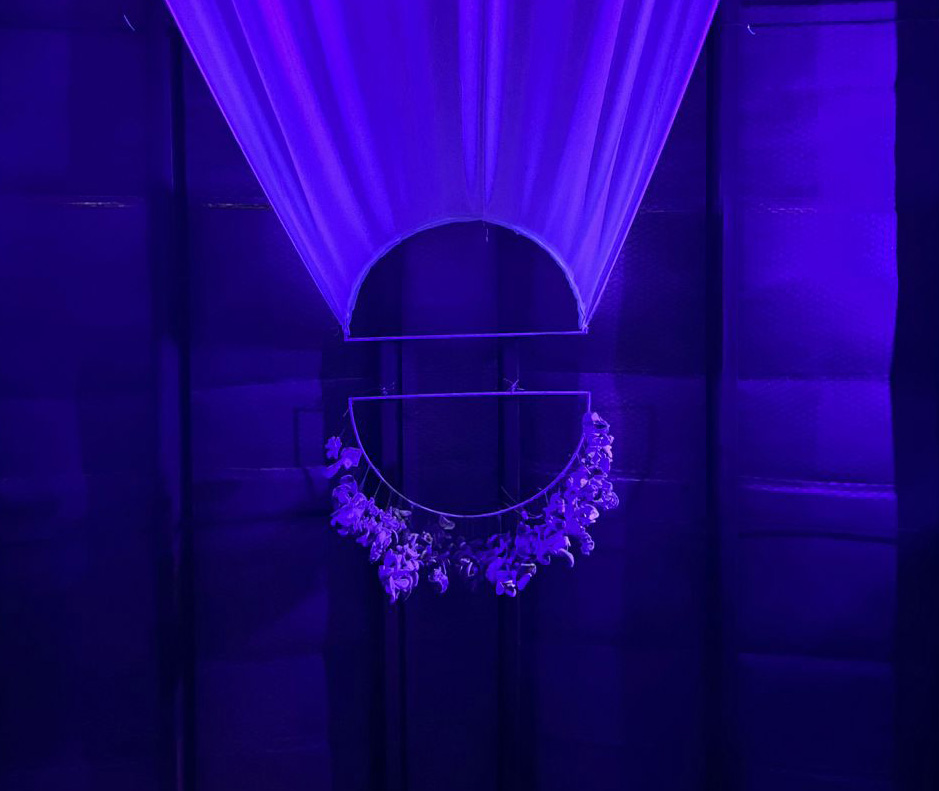
ToMerge: a Question of Participation
“ToMerge” is a collaborative project in which six artists* from different media were invited to collaborate in succession to create a single work. Each artist worked on the work for a limited period of one day and, after completing the intervention, handed it over to the next person. Each stage of the project was required to preserve a part of the previous trace, and this process continued until all artists completed the cycle. Ultimately, what was formed was a work that resulted from the interaction, intertwining, and reflection of the collective actions of the artists. In the process of this project, each individual was simultaneously the creator and heir of the work; each artist both made decisions and lived with the consequences of previous decisions. In this way, the work of art was not simply a passive object and product, but an active and effective agent in each stage of the collective creative process. Although each intervention offered an opportunity to reorganize and open new paths for the next work, the artists’ personal characteristics, media differences, and time constraints all influenced the process of creating the work, reflecting the fact that participation, while simultaneously synergistic, also entails inequality and exclusion.
In this sense, the aim of “ToMerge” went beyond the production of a single work of art: the aim was to experience in practice the concept of collective construction and the role of the relationship between the individual and the other.
Participating artists:
Fariba Boroufar, Mehdi Behboudi, Arezou Zargar, Ali Famori, Mahmoud Maktabi
Curator: Ghazal Refalian
Fascilitator: Afra Nejati
Executive fascilitator: Hamidreza Karami
Venue: Dayhim art society (This exhibition has been suspended until further notice due to the volatile conditions in Iran. 2026/01)